MMSD Grease Trap Rules and Records
What the Milwaukee Metropolitan Sewerage District actually requires from a food service establishment, what an inspector looks at, and the record keeping rule that catches out more kitchens than anything else.
Most compliance guides for this trade are written nationally and localised with a find and replace. This one is not. If your kitchen is in Milwaukee or one of the surrounding communities served by the district, your obligations come from a specific set of rules with specific numbers in them, and knowing those numbers is most of the battle.
Who regulates your discharge
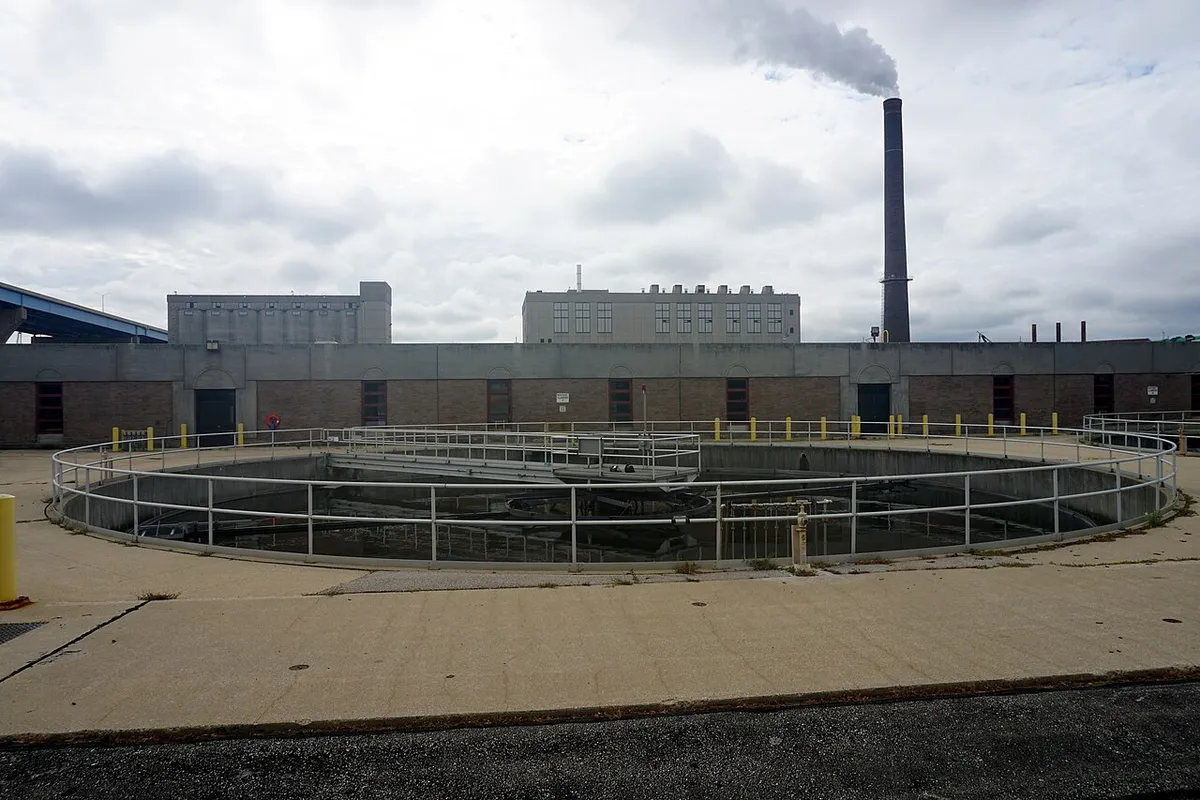
The Milwaukee Metropolitan Sewerage District is the wastewater authority for Milwaukee and a large group of surrounding communities. It regulates the discharge of fats, oils and grease from food service establishments in its service area, and the operative rules live in its Chapter 11 discharge regulations and enforcement procedures, which were most recently amended in 2026. The current rules are published at MMSD rules and regulations.
The district’s authority is not invented locally. Wisconsin’s NR 211 pretreatment rules set the statewide framework under which a publicly owned treatment works establishes and enforces local limits on non domestic dischargers. That is the legal backbone underneath everything MMSD asks a restaurant to do.
The 25 percent rule
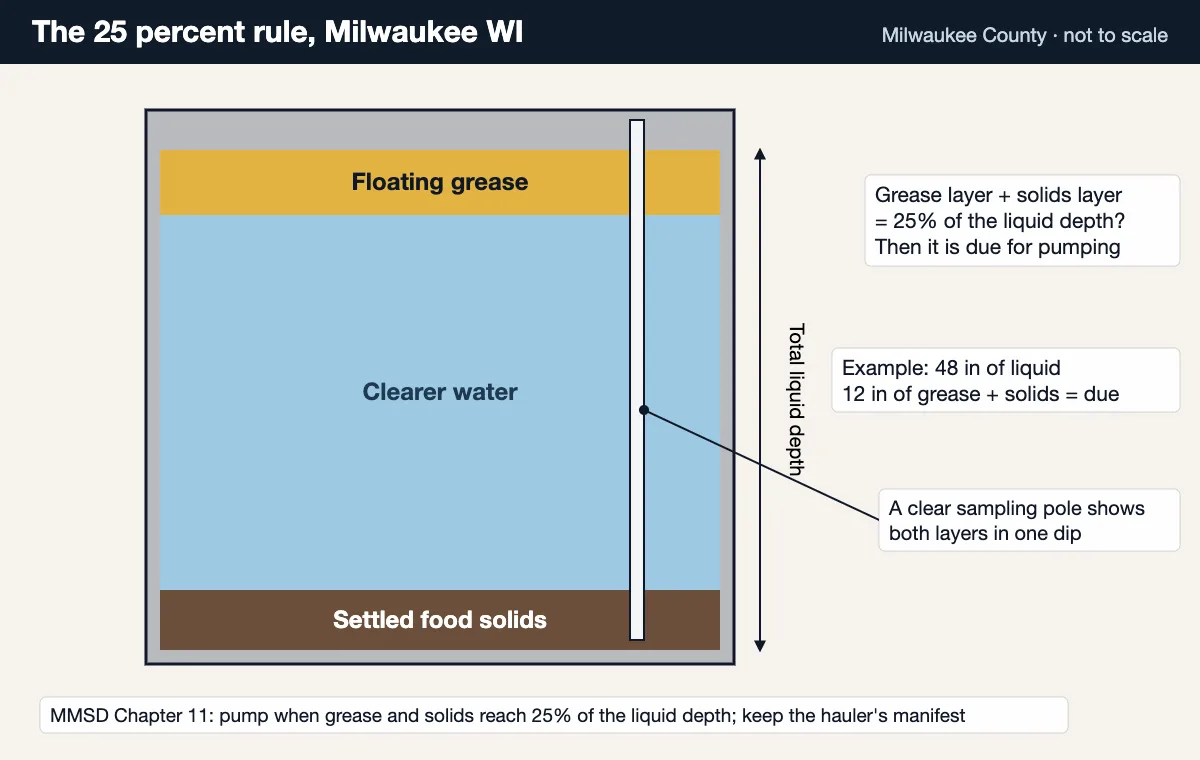
This is the number to remember. A grease interceptor must be pumped when accumulated fats, oils and grease together with settled solids reach 25 percent of the tank’s total liquid depth.
Read that carefully, because it is not a schedule. It is a condition. A kitchen that crosses 25 percent in six weeks is out of compliance at week seven no matter what its service contract says, and a kitchen that takes five months to get there is compliant the whole time. The calendar interval that every hauler quotes is a tool for staying under the threshold, not a separate rule.
The practical consequence is that a kitchen which has changed since its interval was set is the kitchen most likely to be non compliant without knowing it. Nothing about adding a fryer updates the service contract.
Inspections are unannounced
The district inspects food service establishments without advance notice. This matters more than it sounds. A scheduled inspection tests whether you can prepare. An unannounced one tests what your operation looks like on a random Wednesday, which is the actual question.
- Tank condition and accumulated depth, measured against the 25 percent threshold.
- Whether the interceptor is the right one for the kitchen and is functioning, including intact baffles.
- Service records: dates, who performed the work, volumes removed and where the waste went.
- Evidence that the hauler is licensed for the work.
- General housekeeping around the tank and evidence of improper disposal practices in the kitchen.
The three year record rule
Service records must be kept for three years, and the responsibility for keeping them sits with the food service establishment. Not the hauler. This is a very common compliance failure and it is almost never deliberate.
The usual sequence: a general manager set up the binder, the binder lived in their office, the general manager moved on, and the binder went into a box that nobody has opened since. Two years later an inspector asks for history and there is none, even though every single service was performed and paid for.
What a usable record contains
- Date of service.
- Name of the hauling company and evidence of its licence.
- Volume removed, in gallons.
- The tank that was serviced, where a property has more than one.
- Where the waste was taken for disposal.
- A signature from whoever performed the work.
Insist on that record after every visit and ask the hauler to keep a matching copy, so a lost binder is a phone call rather than a violation.
Licensed hauling in Wisconsin
Your waste has to leave on a licensed hauler, and Wisconsin is specific about what that means. A septage servicing business licence is required under NR 113, vehicles used for servicing must be registered and used for no other purpose, a current copy of the rule must be carried in the vehicle, disposal must go to a publicly owned treatment works or a site under a WPDES permit, and an annual report is filed with the state by the end of January. The requirements are published by the Wisconsin DNR.
It is worth asking a prospective hauler about this directly. An operator with a licence answers immediately. An operator without one gives you a price instead of an answer.
Where the city fits in
Alongside the district’s discharge rules, the plumbing installation itself is governed by Wisconsin’s state plumbing code and by the City of Milwaukee plumbing code where applicable. We have deliberately not cited city ordinance section numbers here because we could not verify them from an accessible primary source, and a confidently wrong section number in a compliance guide is worse than no section number at all. If your question is about installation, sizing or replacement rather than ongoing discharge, ask the city plumbing inspector directly.
Getting compliant from a standing start
If you have inherited a kitchen with no records and no idea when the tank was last touched, the path is short. Get a full service with measurements recorded. That single document establishes the tank size, the condition it was in, and a start date for a clean record trail. From there the interval is set from the reading and the history builds itself.
MMSD Compliance Questions
Do I need a permit for my grease trap in Milwaukee?
The thing most operators call a permit is really a combination of two obligations: your plumbing installation has to comply with Wisconsin's plumbing code, and your ongoing discharge has to comply with MMSD's discharge regulations. Requirements vary by property and by what you are installing, so confirm your own situation with the district rather than assuming a neighbor's answer applies to you.
What does an MMSD inspector actually look at?
The condition of the tank, whether accumulated grease and solids have crossed the 25 percent threshold, and your service records. Inspections are unannounced, which means the honest test is what your tank and your binder look like on an ordinary day rather than a day you prepared for.
How far back do my records need to go?
Three years. The obligation sits with the food service establishment, not the hauler. If a manager left and took the binder, the gap is still recorded against you, which is why keeping a second copy with your hauler is worth doing.
Does MMSD set a fixed pumping interval?
The rule that is clearly established is the 25 percent threshold: pump when grease and solids reach 25 percent of total liquid depth. A calendar interval is how you stay under that number, not a separate requirement layered on top of it. Confirm any specific interval requirement for your property directly with the district.
What happens if my records are incomplete?
It depends on the inspector and the rest of the picture, but incomplete records are a very common finding and the most avoidable one. The tank being genuinely clean does not help much if you cannot show when it was last serviced, by whom, and where the waste went.
Start a Clean Record Trail
One documented service with real measurements gives you a defensible starting point. Tell us about the kitchen to get started.
Request Service