Grease Trap Pumping Frequency in Wisconsin
The 25 percent rule, what the state plumbing code requires of your tank, how to take your own measurement, and why a single year round interval rarely survives a Wisconsin winter.
Many kitchens are on an interval that somebody set once and nobody has examined since. Sometimes it is too long and the tank is quietly out of compliance. Reasonably often it is too short and the operator is paying for volume that is not there. Both problems have the same fix, and it takes about four minutes with a stick.
The rule that actually governs
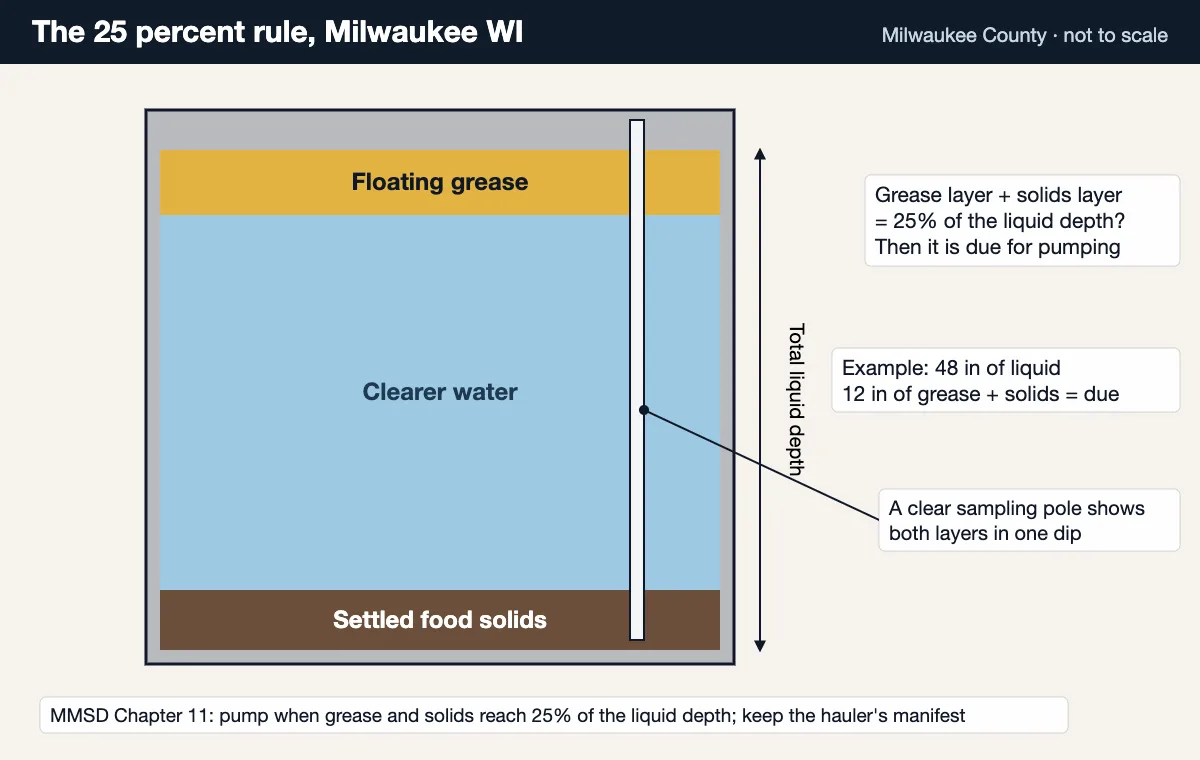
For food service establishments in the Milwaukee Metropolitan Sewerage District service area, the operative standard is the 25 percent rule: the tank must be pumped once accumulated grease and settled solids together reach 25 percent of the tank’s total liquid depth.
Notice that this is a condition, not a calendar. Nothing in it says 90 days. A calendar interval is a way of ensuring you never reach the threshold, which is a sensible operating strategy, but it is derived from the rule rather than being the rule. This distinction matters the moment your kitchen changes, because the interval does not update itself when you add a fryer.
How to measure your own tank
You do not need equipment. A clean wooden or plastic measuring stick long enough to reach the floor of the tank is sufficient, and the whole exercise takes a few minutes.
- Lower the stick vertically to the bottom of the tank and note where the liquid surface sits. That is total liquid depth.
- Withdraw it slowly. The grease cap leaves a distinct band at the top of the wetted length. Measure that band.
- The settled solids leave a darker, heavier deposit at the bottom of the stick. Measure that too.
- Add the grease cap thickness to the solids depth, divide by total liquid depth, and multiply by 100.
- Over 25 percent means the tank is due now. Between 15 and 25 percent means you are approaching it and should book. Under 10 percent consistently means your interval is probably shorter than it needs to be.
Do this twice, a month apart, and you have an accumulation rate. From a rate you can project the date the tank will hit 25 percent, and that projection is your interval. It is the entire method, and it is more accurate than anything a hauler can tell you over the phone.
What Wisconsin requires of the tank itself
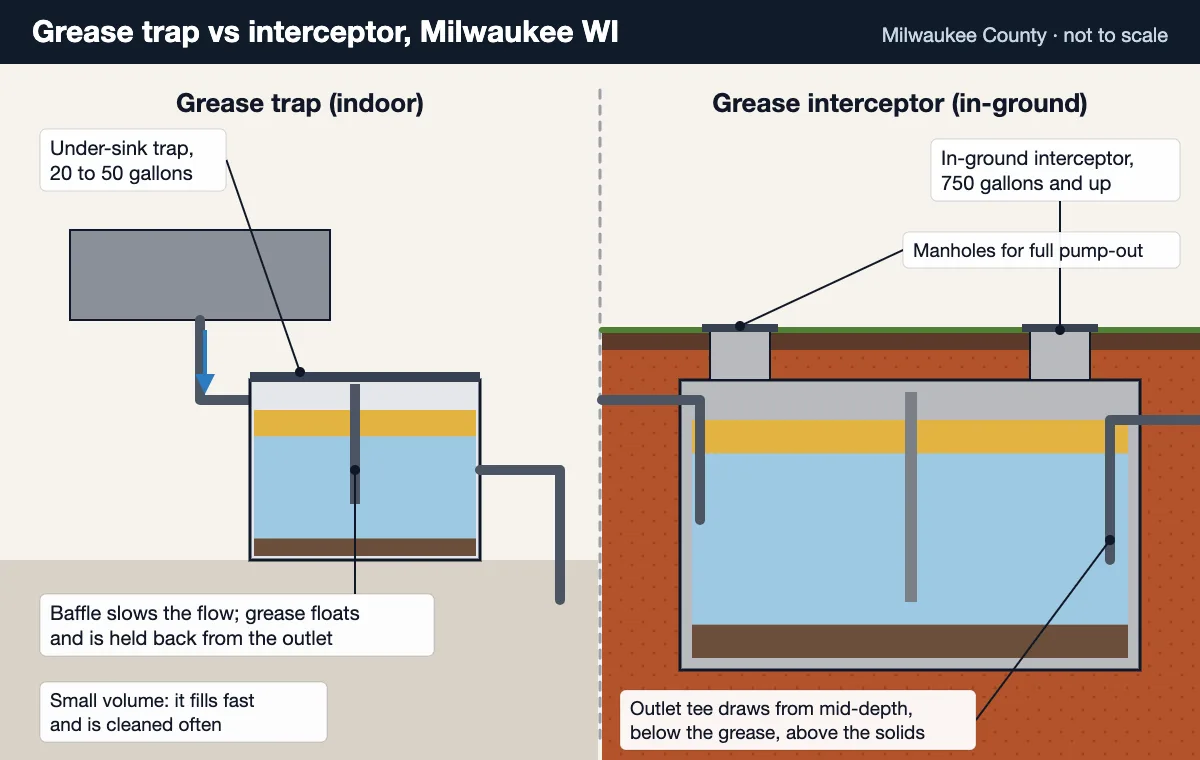
Frequency and sizing are related, because a tank that is too small for its kitchen will always need an interval that feels unreasonable. Wisconsin’s plumbing code sets the minimums in SPS 382.34.
Interior interceptors
- Minimum rated flow of 15 gallons per minute.
- Three quarters of the total holding capacity of the connected fixtures must not exceed the interceptor's maximum rated flow rate.
- Grease holding capacity in pounds must be at least twice the maximum rated flow rate in gallons per minute. A 20 gpm unit therefore needs at least 40 pounds of grease capacity.
- A submerged horizontal inlet may not exceed 12 inches.
Exterior interceptors
- Minimum sizing may be halved where a kitchen uses all disposable service, but may not fall below 1,000 gallons where a private sewage system is used or 750 gallons where discharge goes to a municipal sewer.
- Siting setbacks apply: 5 feet from a building, 10 feet from a water service, 2 feet from a lot line and 10 feet from a cistern or reservoir.
- No grease interceptor may be located where surrounding temperatures under operating conditions are less than 40 degrees Fahrenheit.
That last provision is the one operators in this state should read twice. It is a temperature requirement written into the plumbing code, and in a Wisconsin winter it is not hypothetical.
What moves your interval
Menu, not covers
Two restaurants doing identical covers can load a tank at very different rates. Fryers, heavy saute, dairy and anything involving rendered animal fat put substantially more into the trap than a salad and sandwich operation at the same volume.
Tank size relative to the kitchen
The most common cause of an unreasonably short interval is a tank that was correctly sized for a smaller operation. An interval that keeps getting shorter while nothing about the tank changes is a sizing message rather than a scheduling one.
Practices at the dish pit
Scraping plates properly, strainers at every sink, fryer oil going to a rendering container rather than a drain, and nobody flushing a slow drain with hot water. Each of these extends an interval measurably and all of them decay with staff turnover.
Season
Wisconsin is where the generic national advice breaks down. Cold reduces separation efficiency and produces a denser, harder cap on outdoor tanks. The correct approach is a shorter winter interval rather than a single annual number that is too long for half the year.
Turning a measurement into a schedule
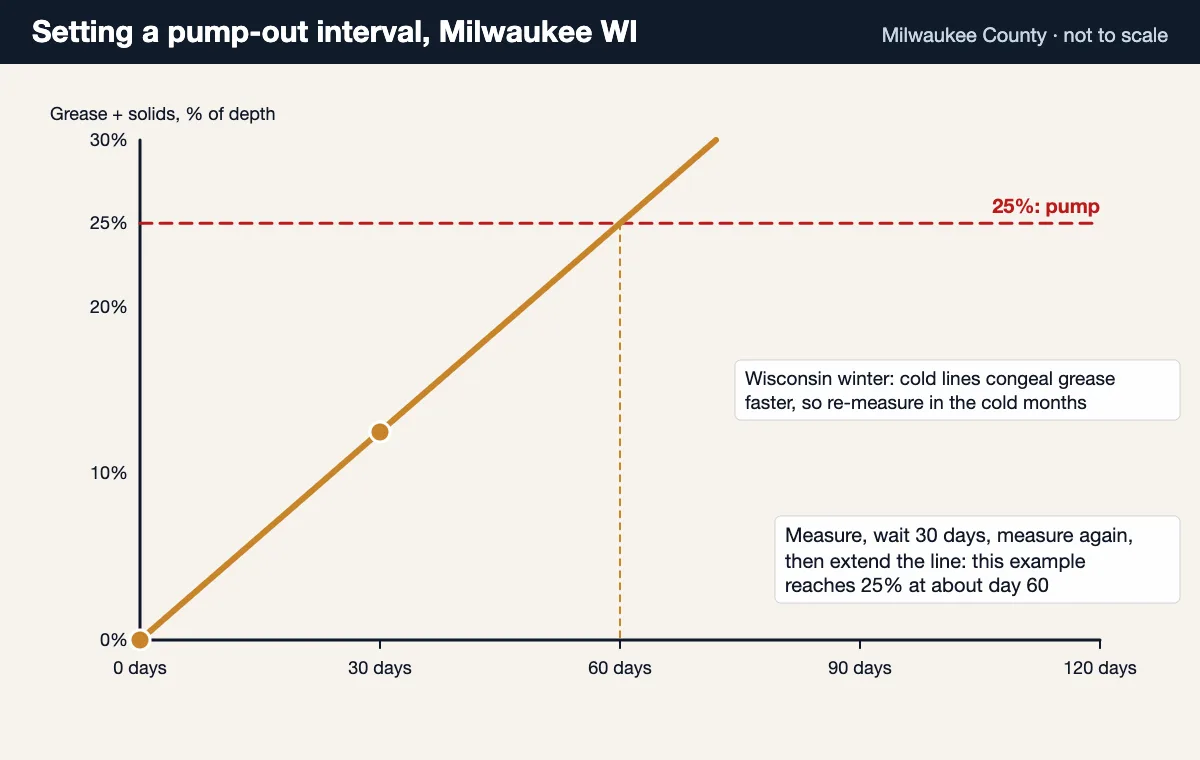
Take the reading. Calculate your percentage. If you know roughly when the tank was last serviced, you now have an accumulation rate over a known period. Project forward to 25 percent, subtract a couple of weeks of margin, and that is your interval. Re-check it annually, and any time the kitchen changes materially.
If that sounds like more attention than you want to give a concrete box in the parking lot, that is entirely reasonable and it is what a maintenance program is for. The hauler takes the reading, sets the interval and re-measures when things change.
Frequency Questions
How often should a grease trap be pumped in Wisconsin?
As often as it takes to stay under 25 percent of total liquid depth in accumulated grease and solids. For most Wisconsin kitchens that works out between 60 and 90 days, but the correct answer for your tank depends on your volume, your menu and your tank size, and the only way to know it is to measure.
Where does the 90 day figure come from?
It is a practical industry baseline rather than a universal legal mandate, and it exists because it happens to keep a typical kitchen with a correctly sized tank under the threshold. Treat it as a starting assumption for a new account, not as a rule you are compliant with by definition.
Can I measure the tank myself?
Yes, and it is genuinely useful. A clean measuring stick lowered to the tank floor will show you total liquid depth, the thickness of the grease cap at the top and the depth of settled solids at the bottom. Add the cap and the solids together and divide by total depth. Over 25 percent means it is due.
What size trap does Wisconsin require?
The state plumbing code sets minimums. Interior interceptors must be rated at a minimum of 15 gallons per minute, three quarters of the total holding capacity of connected fixtures must not exceed the interceptor's maximum rated flow, and grease holding capacity in pounds must be at least twice the maximum rated flow in gallons per minute.
Does the interval change in winter?
In Wisconsin it usually should. Grease separates less effectively at low temperatures and an outdoor tank running cold accumulates a harder, thicker cap. A tank that comfortably makes 90 days in summer frequently will not make it in February on the same schedule.
Keep Reading
What a full service includes, local pricing, and how to book a first visit.
The winter half of the schedule, and the 40 degree provision in state code.
Where the 25 percent rule comes from and what else the district requires.
Handing the measuring and the scheduling to someone else entirely.
Find Out What Your Interval Should Be
One measurement replaces a guessed schedule with a real one, in either direction. Plenty of kitchens find out they have been paying for service they did not need.
Request Service