Grease Trap Cleaning Cost in Milwaukee
Real local ranges rather than a national average, what the disposal fee share of a call actually is, and the reason two quotes for the same tank can differ by half.
Nobody enjoys researching this. The reason it is worth ten minutes is that grease trap pricing has an unusually wide honest range and an unusually common dishonest one, and telling them apart from a quote alone is difficult unless you know what the numbers should look like.
Reported Milwaukee figures put a typical service somewhere between 303 and 436 dollars, with the full observed range spanning roughly 103 to 747 dollars. That spread is not inconsistency in the market. It is the difference between a small under sink unit and a large in ground interceptor, which are fundamentally different jobs that happen to share a name.
Milwaukee price ranges by tank size
Most common in small restaurants, cafes and bars
Older Milwaukee buildings, often undersized for current volume
Standard for mid size restaurants with outdoor access
Hotels, banquet kitchens, food halls, institutional
A truck leaving a planned route, often outside normal hours
Ranges reflect reported Milwaukee market figures and typical trade pricing by tank size. Your quote depends on your specific tank, its condition and access.
What actually drives the number
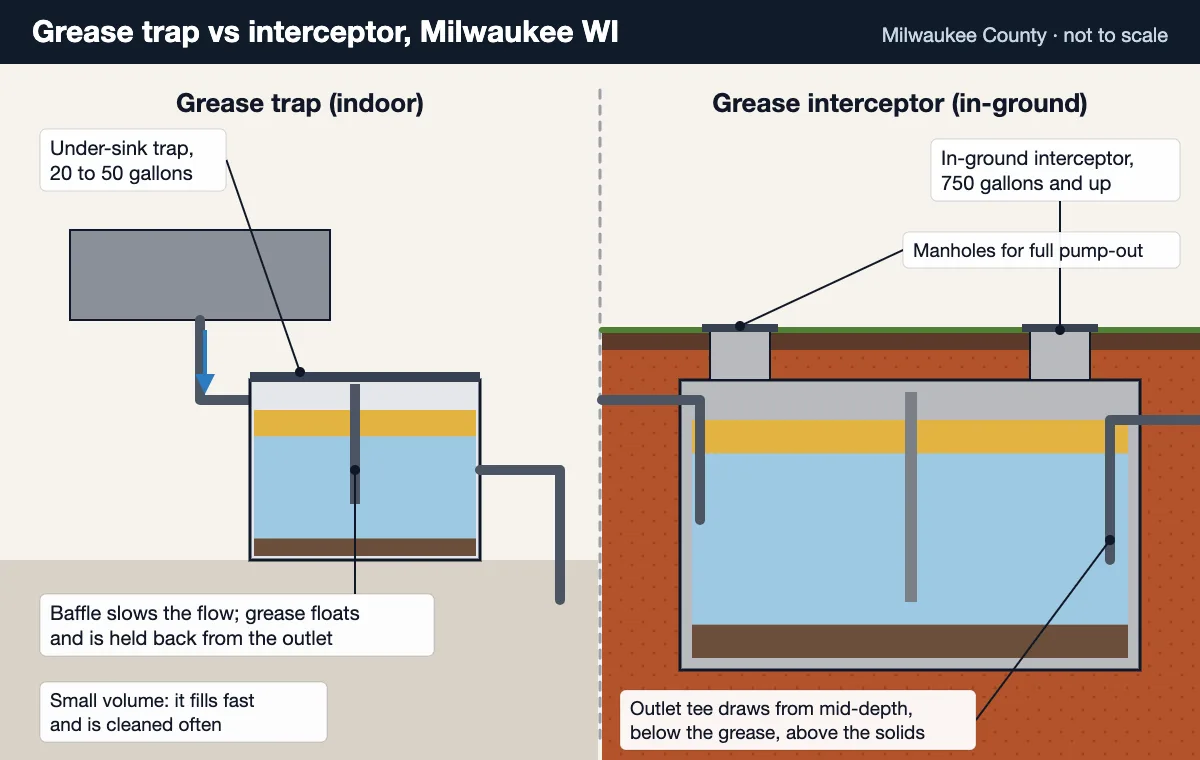
Gallons removed, above everything else
Grease trap waste is regulated septage in Wisconsin. It has to be hauled by a licensed operator in a registered vehicle and taken to a publicly owned treatment works or a WPDES permitted site. Somebody pays to receive it, and on a large interceptor call that disposal and tipping cost commonly represents 150 to 450 dollars of the invoice on its own.
This is why volume dominates. It is a hard cost that scales with gallons and does not care who is holding the hose. Any quote that prices a 1,500 gallon tank at under sink rates is quoting for removing less than the tank contains. The discharge rules that sit behind all of this are published by MMSD.
How full the tank is at service time
A tank serviced at the 25 percent threshold has less in it than the same tank serviced at 70 percent. Staying on a correct interval is therefore cheaper per visit as well as safer, which is one of the few places in this trade where the right thing and the cheap thing point the same direction.
Access
A lid in an open lot is a routine stop. A lid behind a locked gate, under a dumpster, in a Third Ward alley that fills with delivery vehicles by eight, or requiring a long hose run from the nearest legal parking spot, is a longer one. In dense parts of the city access is frequently the difference between a 45 minute job and a two hour job.
Winter compounds this. A lid under packed plow snow has to be found and excavated before anything else can happen.
Tank condition
A long neglected tank takes longer, and sometimes what turns up changes the conversation entirely. Collapsed baffles, groundwater infiltration or a lid that has been paved over are not pumping problems and cannot be priced as pumping problems.
The skim discount, and what it really costs
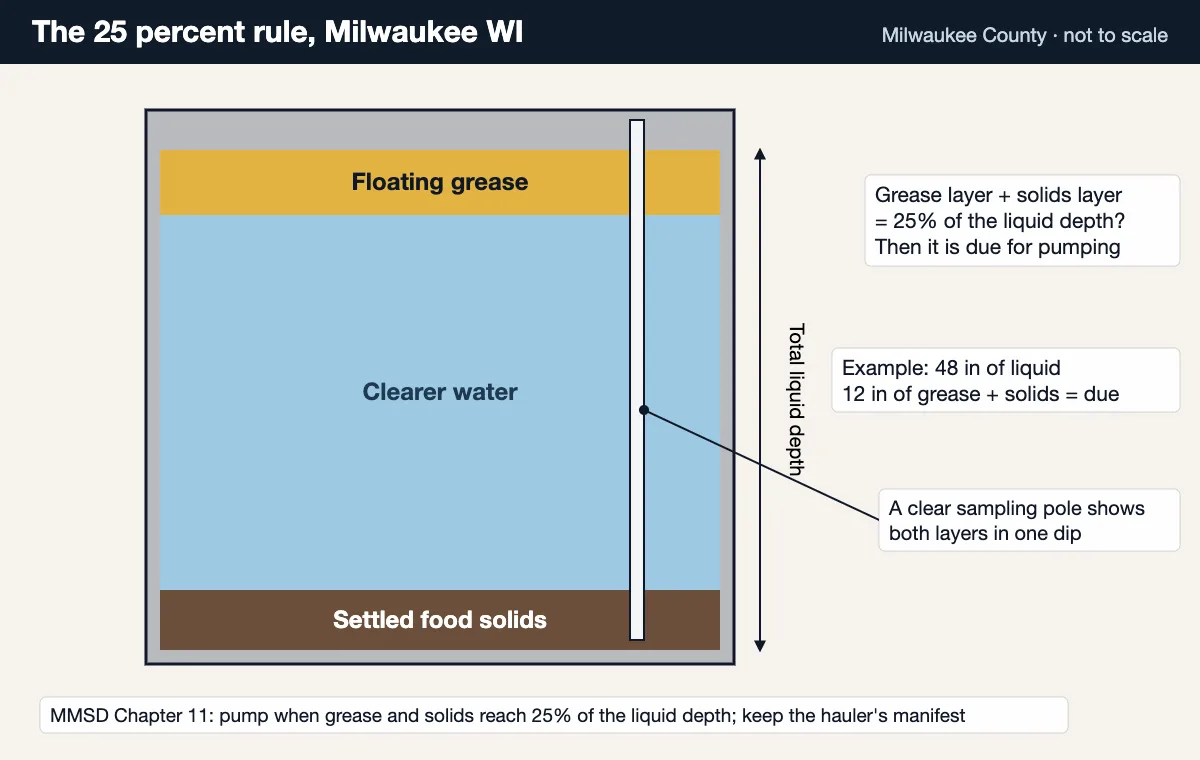
The single most common reason one Milwaukee quote is dramatically below another is that it is for a partial service. The grease cap comes off, the tank looks empty through the lid, and the invoice says cleaning. The settled solids stay exactly where they were.
The cost of the skim is not the price difference. It is that your working volume never gets restored, so the interval shortens, so you pay more often, and eventually the tank stops separating and grease starts leaving through the outlet into your lateral. A blocked lateral is a four figure problem. The 150 dollars you saved on the invoice is not a meaningful offset.
Scheduled versus reactive, in money
- A scheduled route stop is the cheapest version of this service because the truck was going to be nearby anyway.
- A one off call at normal hours costs more, because it is a dedicated trip.
- An emergency call costs more again, because it pulls a truck off a planned route and frequently happens outside normal hours.
- An emergency that has already progressed to a blocked lateral costs the emergency call plus line clearing, and is routinely several times the annual cost of simply being on a schedule.
- Lost revenue from a kitchen that cannot serve is the cost nobody puts on the comparison, and it is usually the largest number on it.
What a quote is based on
Tank type and size, access, current condition, and whether this is a one off or the start of a schedule. If you do not know your tank size, that genuinely does not block a quote. Plenty of kitchens have no idea, and establishing it is part of the first visit. Be wary of any quote that assumes a small tank and then gets revised upward on site.
Cost Questions From Milwaukee Operators
What is the average cost of grease trap cleaning in Milwaukee?
Reported Milwaukee averages sit around 303 to 436 dollars per service, with the full observed range running from roughly 103 dollars to 747 dollars. The average is not very useful on its own, because the spread is driven almost entirely by tank size and a 20 gallon unit and a 1,500 gallon interceptor are not the same purchase.
Why is one quote half the price of another for the same tank?
Almost always scope. The cheaper quote is usually a skim: the floating grease cap gets removed and the settled solids stay on the floor of the tank. It looks identical on the day and fails far sooner, because the solids layer is what determines your remaining working volume.
How much of the bill is disposal?
On a large interceptor service call, disposal and tipping fees commonly account for something like 150 to 450 dollars of the total. That portion scales with volume regardless of who does the work, which is why gallons removed is the dominant cost driver in this trade.
Is a maintenance contract cheaper than calling as needed?
Per visit, usually yes, because a route stop is more efficient than a one off. The larger saving is avoided emergencies. An overflowing trap on a Saturday night costs an after hours call plus, frequently, a line clearing bill, and the kitchen loses revenue while it happens.
Does winter cost more?
It can on outdoor interceptors, because a frozen lid or a solidified cap takes longer to deal with and time is what you are buying. Marking the lid before the first plow and shortening the interval through winter are both cheaper than the alternative.
Get a Real Number for Your Tank
Send the business, the neighborhood and whatever you know about the trap. You get a quote based on your actual tank rather than a range you have to interpret.
Request Service