Emergency Grease Trap Service in Milwaukee
Backed up traps, overflowing floor drains and inspection findings with a clock on them. What to do first, and what to tell a hauler.
Grease emergencies have a schedule of their own, and it is almost perfectly inverted from the one you would choose. They happen on Friday and Saturday nights, during brunch, during a holiday party, in the middle of the busiest two hours of the week. That is not bad luck. It is the load. A tank that has been marginal for weeks fails at the exact moment the kitchen pushes the most volume through it.
When that happens the important thing is speed and an accurate description of the problem, because the two most common Milwaukee grease emergencies need completely different responses.
What to tell us when you send the request
- Business name and neighborhood, so the hauler knows where you are and what the access looks like.
- What you are actually seeing. Water rising in a floor drain is different from a dish pit draining slowly, which is different again from grease visible at an outdoor lid.
- Whether you are still serving. A kitchen mid service and a kitchen already closed get different handling.
- Roughly when the trap was last pumped, even if the answer is that nobody knows.
- Whether an inspector has been involved and whether there is a deadline attached.
The three most common emergencies in this city
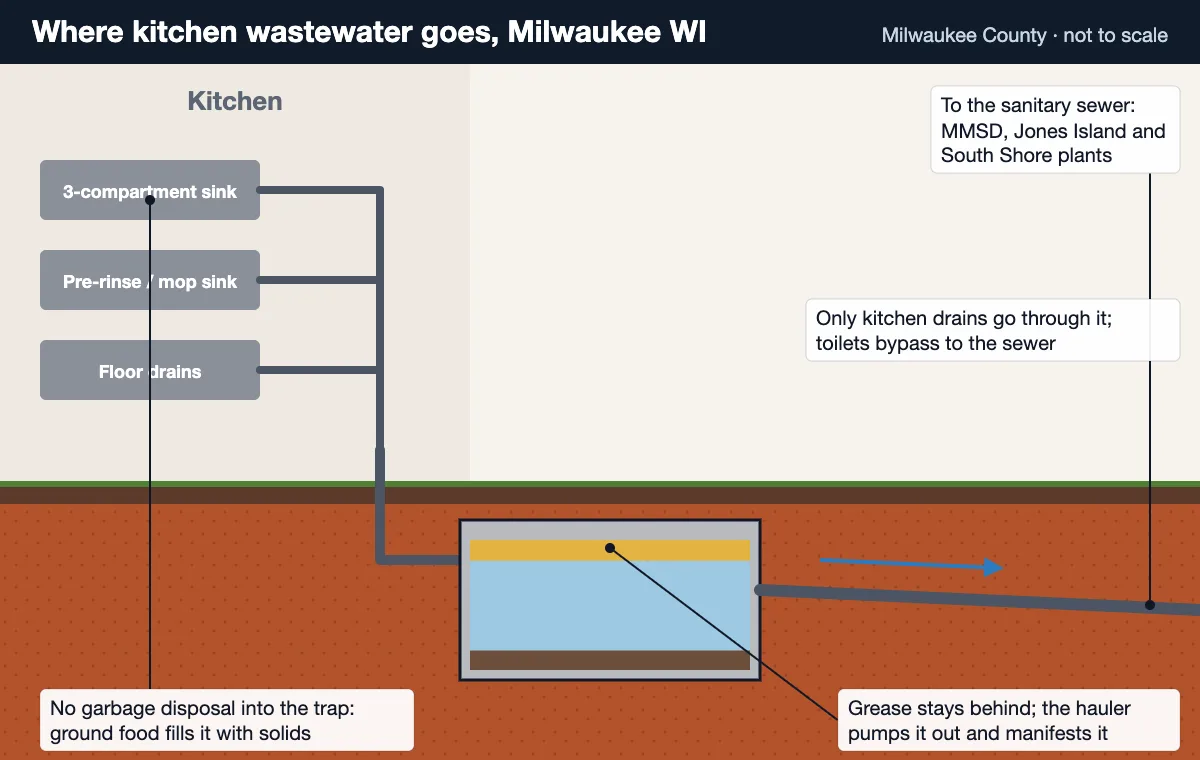
The overflowing tank
Usually an indoor trap, usually one that has been running past the 25 percent threshold for a while. The tank is full, the inlet cannot push flow through, and water backs up into the lowest fixture in the room. This is the fastest of the three to fix because the problem is entirely contained in the tank. Pump it out fully, scrape it, and the kitchen is working again before service is over.
The choked lateral
Harder, and more expensive. Here the trap stopped separating some time ago, grease has been passing out of the outlet and cooling on the inside of the lateral, and the pipe has gradually narrowed until it choked. Pumping the tank alone does not fix this one. The line has to be cleared as well, and the tank service that should have happened months ago still has to happen after. This is the scenario that turns a deferred 400 dollar service into a four figure evening.
The compliance emergency
No water anywhere, no backup, no smell. An inspector has looked at the tank or the records and found a problem, and there is a short window to demonstrate the tank has been serviced and the history reconstructed. These are stressful in a different way and they usually resolve cleanly, because the fix is a documented pump out rather than a repair.
Winter emergencies are their own category
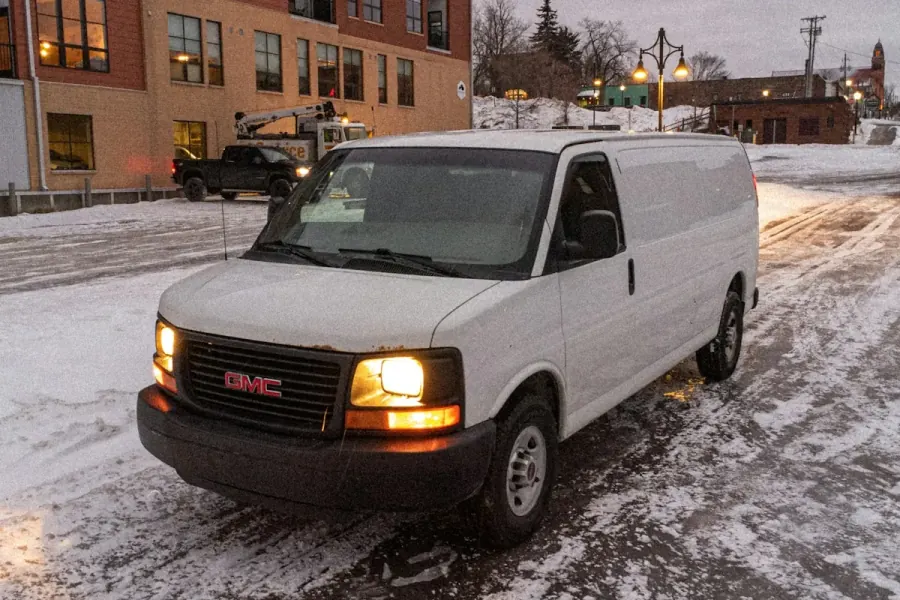
A Milwaukee January produces failures that simply do not exist in warmer markets. Outdoor interceptor caps go solid. Lids freeze into place or disappear under plow snow. Tanks running well below the 40 degree threshold that Wisconsin plumbing code sets for interceptor siting separate poorly and reach the pump threshold faster than the calendar suggests.
The practical version: a tank that comfortably made 90 days through the summer very often will not make it through February on the same schedule, and the failure tends to arrive during a cold snap when access is at its worst. Shortening the winter interval is cheaper than any of it.
After the emergency
Every emergency should end with the same conversation, and it is short: measure what was in the tank, work out what the interval should have been, and set a schedule that keeps you under the threshold. Almost every emergency in this trade is a scheduled service that got deferred one time too many, and the fix is not complicated. It is just easier to ignore in October than it is in February.
Emergency Service Questions
What counts as an emergency?
A trap or interceptor that is overflowing, a floor drain backing up during service, a dish pit that has stopped draining entirely, or an inspection finding that gives you a short window to demonstrate the tank has been serviced. Anything that shuts a kitchen down or puts a health department clock on you.
How fast can someone get to me?
Response time depends on who is available, so send the request as early as you can with the business name, the neighborhood and what you are seeing, and be specific: overflowing is a different job to slow draining and gets a different response.
Can a grease trap be serviced after hours and on weekends?
Often, yes. Grease emergencies are concentrated in exactly the hours a kitchen is busiest, which is why after hours service exists in this trade at all. Ask about availability and the after hours rate when you send the request. A tank that backs up at eight on a Saturday does not wait until Monday for anybody.
The backup is in my floor drain, not the trap. Is that still your problem?
Usually yes. A floor drain backing up is very often the first visible symptom of a trap that has stopped separating and a lateral that has been quietly accumulating grease for months. A good hauler will tell you honestly if what you have is a plumbing problem rather than a grease problem.
Is emergency service more expensive?
Yes, and there is no honest way around that. An emergency call means a truck leaves a planned route, often outside normal hours. It is still dramatically cheaper than a closed kitchen on a Saturday night, which is the real comparison.
Keep Reading
What a full service includes and why a skim is not a cleaning.
How to work out the interval that keeps you out of this page entirely.
What an inspector asks for and how to reconstruct a missing record trail.
Coverage from the Third Ward to the county line and out to Waukesha.
Say what is happening in the first line and it gets treated as urgent.
Backed Up Right Now?
Send the business name, the neighborhood and what you are seeing. Say it is urgent in the first line, and send it early rather than at closing.
Request Service