Grease Interceptor Cleaning in Milwaukee
In ground tanks from 750 gallons up. Every chamber emptied, every baffle checked, and lot access planned around your deliveries rather than the other way round.
The interceptor is the tank most Milwaukee operators have never seen. It sits under the parking lot or the alley, it has a heavy lid, and the only evidence it exists for most of the year is a line item on an invoice. That invisibility is exactly why interceptors are where the expensive failures happen. Nobody notices a problem developing in a tank nobody opens.
In ground interceptors across the city and the surrounding suburbs run from 750 gallon single chamber tanks behind small restaurants to large multi compartment systems under hotel and institutional kitchens.
Why interceptors fail differently to traps
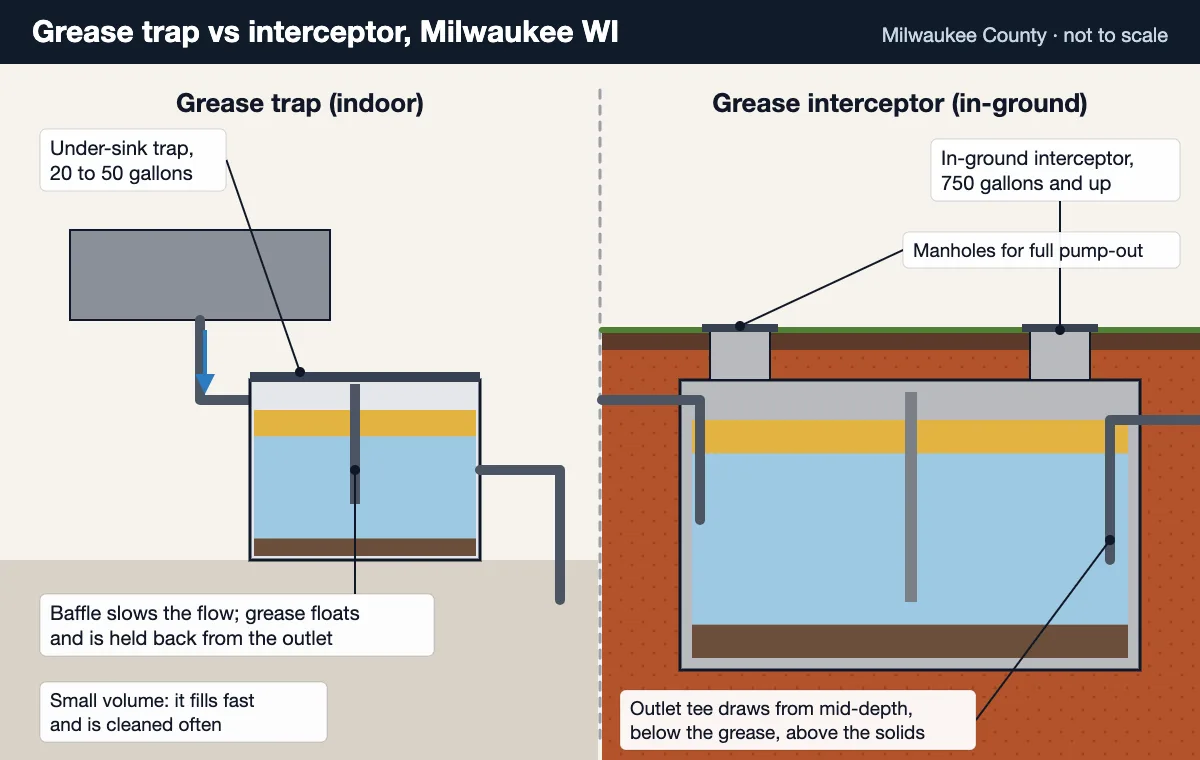
An under sink trap fails quickly and obviously. It is small, it fills fast, and when it stops working the dish pit tells you within days. An interceptor holds enough volume to disguise a developing problem for months. By the time a 1,500 gallon tank makes itself known, the failure is usually structural rather than a matter of being full.
- A collapsed or missing baffle lets incoming flow travel straight to the outlet, so grease leaves the tank no matter how recently it was pumped. The tank looks fine through the lid. The lateral does not.
- Solids compaction on the floor of the tank permanently reduces working volume. A tank that reads as half full may have lost a third of its capacity to a hardened solids layer that a skim never touches.
- Groundwater infiltration through degraded concrete joints dilutes the contents and produces a tank that is always full and never seems to hold much grease.
- Downstream chambers that have never been opened. Extremely common, and usually the single biggest cause of an interceptor that no longer separates.
- Lids that have been paved, parked or built over, which converts a routine service into a excavation conversation.
What a full interceptor service involves
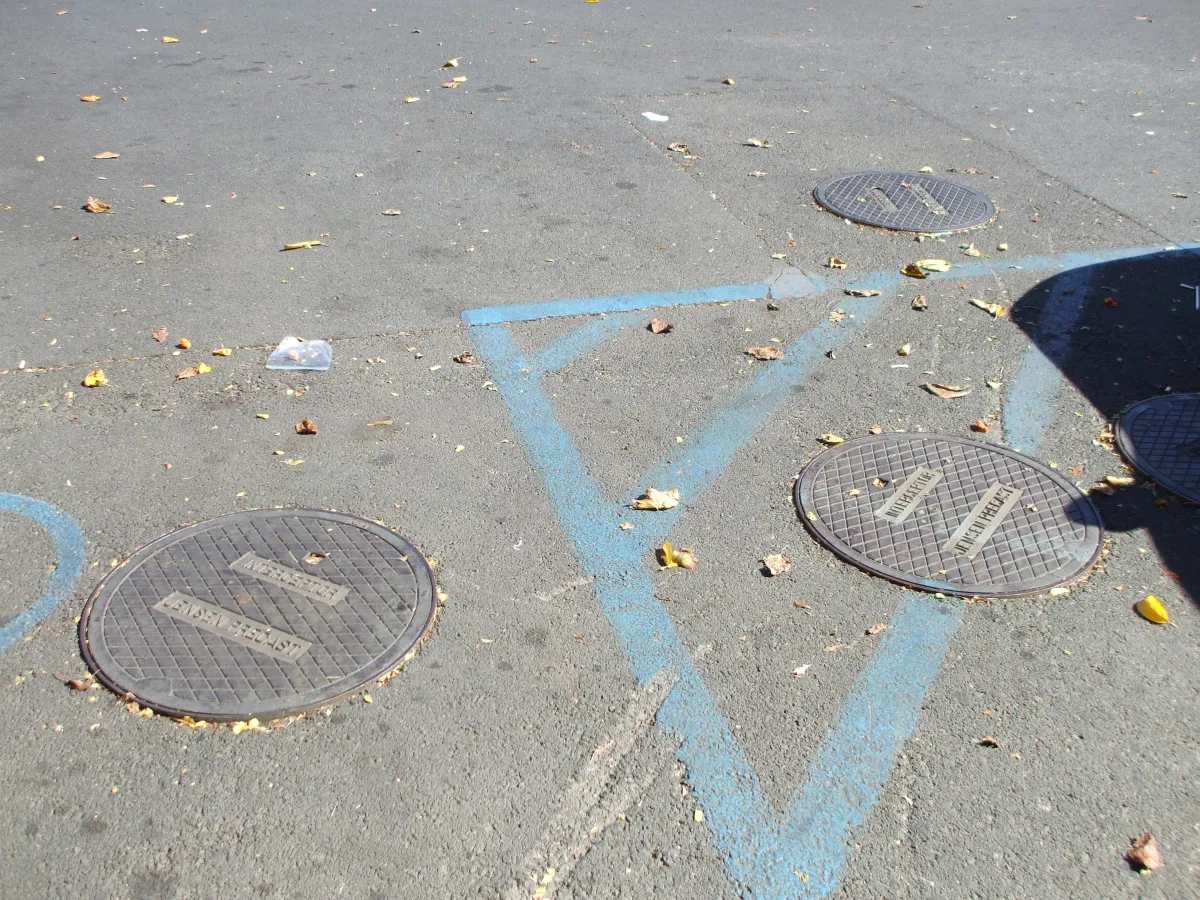
Every chamber is opened. Contents are pumped out completely, top to bottom, which means the floating grease cap, the liquid column and the compacted solids on the floor. Walls and baffles are scraped. Each baffle is physically checked, because a baffle that has failed is the difference between a tank that works and a tank that is just an expensive hole.
Then the readings and the paperwork. Depth measurements go on the ticket alongside gallons removed so your tank has a documented history rather than a series of unconnected invoices. Under MMSD rules those records have to be kept for three years by the food service establishment, so the paperwork is not an administrative courtesy, it is part of the job.
Access in a Milwaukee lot
The truck has to reach the lid
This is the constraint that decides how long a job takes and, honestly, what it costs. An interceptor lid in an open lot is a straightforward stop. The same tank behind a locked gate, under a dumpster that nobody can move, or 120 feet of hose run away from where a truck can legally park is a different job entirely. Dense neighborhoods like the Historic Third Ward and Downtown often mean working early, before deliveries and before street parking fills.
Winter changes the equation
Snow, ice and plowed piles do not cancel interceptor work but they do reshape it. The single most useful thing a Milwaukee operator can do is mark the lid location before the first plow of the season. Finding a buried lid under packed plow snow with a truck idling is slow, and slow is what you are paying for.
Cold also matters inside the tank. Wisconsin plumbing code is explicit that no grease interceptor may be located where surrounding temperatures under operating conditions fall below 40 degrees Fahrenheit, and a large outdoor tank in a Milwaukee January sits close to that line. A cold tank sets up a harder cap, separates less effectively and holds less usable volume, which is why a summer interval frequently does not survive winter.
Sizing, and why so many are wrong
Wisconsin sets exterior interceptor minimums, and allows them to be halved where a kitchen uses all disposable service, but not below 1,000 gallons where a private sewage system is involved or 750 gallons where the discharge goes to a municipal sewer. Those are floors, not targets. An interceptor sized to the floor for a kitchen that has since doubled its covers is undersized in practice even though it was compliant when installed.
The symptom is always the same: an interval that keeps shortening. If your tank needed service twice a year five years ago and needs it every two months now, and nothing about the tank has changed, the kitchen outgrew it.
Booking interceptor work
Tell us the business, the neighborhood and where the lid is if you know. If you do not know where the lid is, say that too. Finding it is a normal part of a first visit on older Milwaukee properties and it is better to spend twenty minutes locating it on a calm Tuesday than at nine at night during a backup.
Interceptor Cleaning Questions
What is the difference between a grease trap and a grease interceptor?
Size and location, mostly. A trap is the smaller indoor unit rated in gallons per minute, usually under a sink. An interceptor is the large in ground tank outside, usually 750 gallons or more, accessed through a lid in the lot. Wisconsin's plumbing code sizes and sites them under separate rules, and only one of them needs a vacuum truck.
Do all the chambers need to be pumped?
Yes. A multi compartment interceptor only works if every chamber is doing its job, and a downstream chamber that has never been emptied is usually the reason a tank has stopped separating. If a previous hauler only ever opened the inlet lid, expect the second visit to take longer.
How do I know how big my interceptor is?
Often nobody in the building does, especially in older Milwaukee properties. It can be worked out from the tank dimensions on the first visit. You do not need the answer before requesting a quote, it is part of what the first service establishes.
My interceptor lid has been paved over. Can it still be serviced?
Not until it is exposed again, and that is a real problem worth solving quickly. A tank nobody can open is a tank that is guaranteed to fail at some point, and the failure will be a backup rather than a scheduled inconvenience. Expect to be told what it will take to get access back.
Does groundwater get into in ground tanks?
It can, particularly in older concrete interceptors with degraded joints. The symptom is a tank that is fuller than your volume explains and a grease cap thinner than it should be. A good hauler checks for it and flags it, because pumping groundwater at grease waste rates is an expensive way to do nothing useful.
Keep Reading
What a full service includes, local pricing, and how to book a first visit.
Why a Milwaukee winter shortens intervals and what the 40 degree rule means.
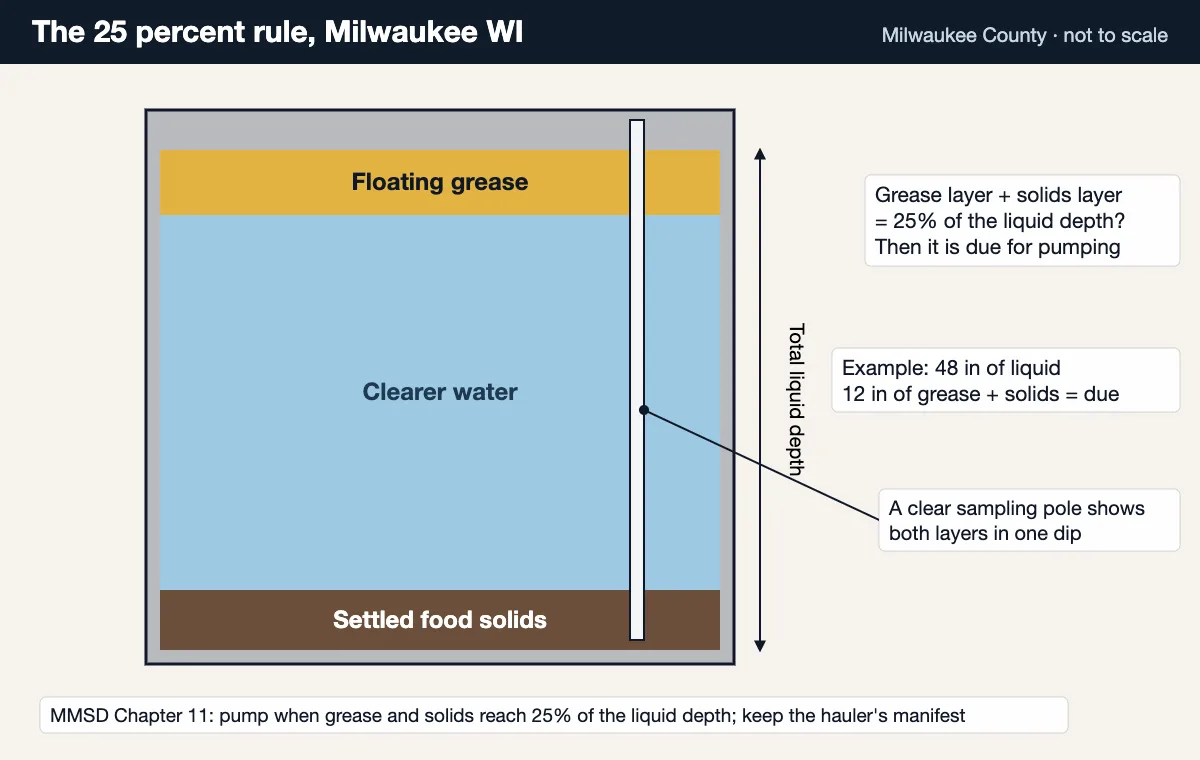
The 25 percent rule and how to measure a tank yourself between services.
Vacuum truck service, disposal records and what a route stop looks like.
Milwaukee neighborhoods, county suburbs and where access gets complicated.
Send the building type and lot access to get a quote for the real job.
Find Out What Is Actually in Your Interceptor
One full service with real measurements tells you more about your system than five years of invoices. Send the business details to get a visit booked.
Request Service